Compost and Organic Matter for Tropical Gardens
Compost and organic matter can improve tropical garden soil tremendously, but more is not always better. Understanding how organic materials behave in a hot, wet climate will help you build healthier soil without creating new problems.
In a tropical garden, organic matter is constantly being broken down. Warm temperatures, moisture, insects, fungi and soil microorganisms all work together to decompose fallen leaves, roots and other plant material.
This is one reason tropical forests can look incredibly lush even though their soils are not always naturally rich. Nutrients are continuously being recycled between plants, dead organic material and the soil.
In our home gardens, however, fallen leaves are often swept away, grass clippings are discarded and garden beds are repeatedly disturbed. Adding compost and other suitable organic materials helps restore part of this natural nutrient cycle.
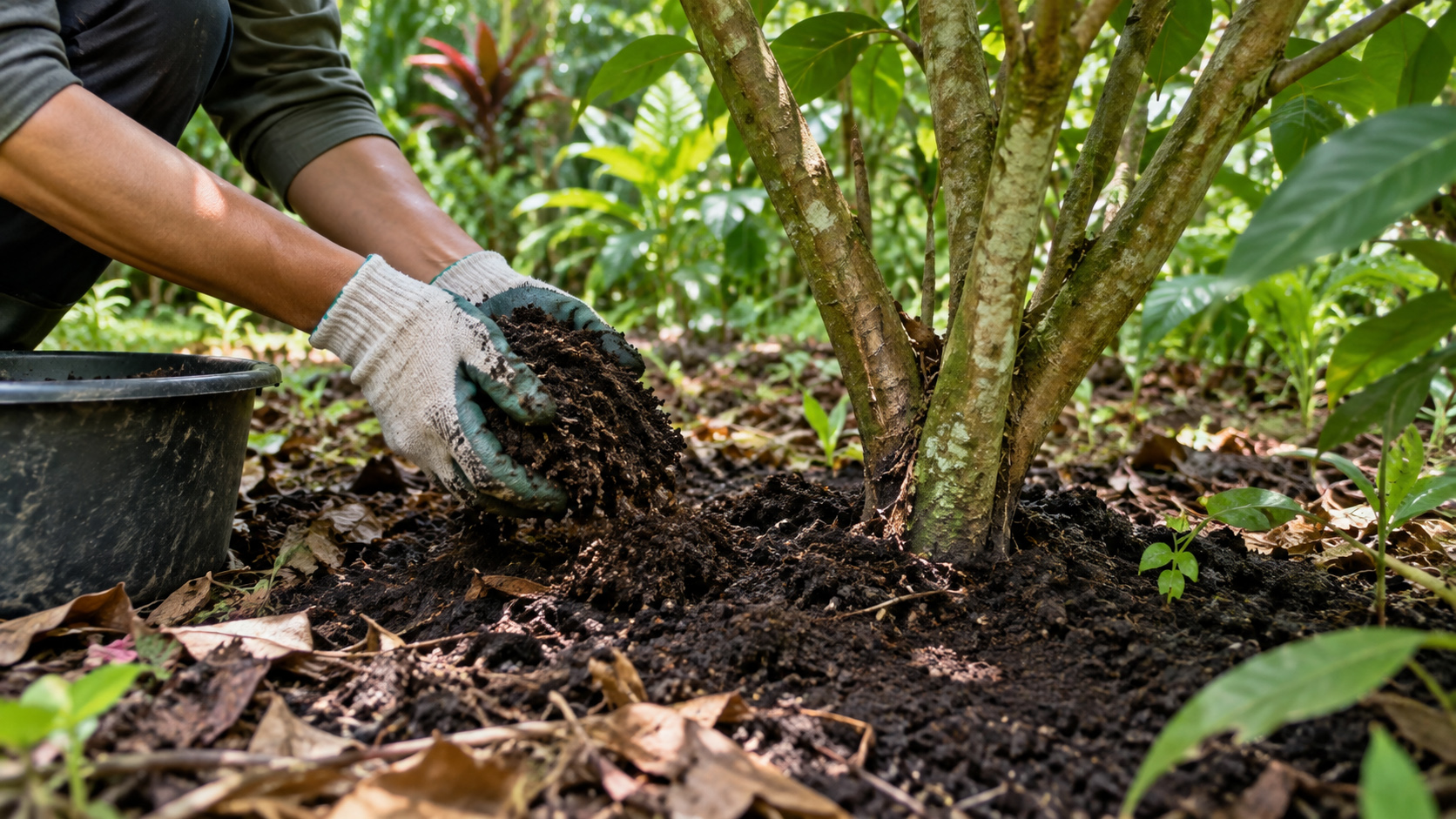
Organic matter helps recreate part of the natural nutrient cycle that occurs on a forest floor.
What Is Organic Matter?
Organic matter simply refers to material that originated from living organisms. In the garden, this can include fallen leaves, decomposed roots, grass clippings, compost, animal manure, bark and many other plant- or animal-based materials.
Not all organic matter is at the same stage of decomposition. A freshly fallen leaf is organic material, but it behaves very differently from mature compost that has already decomposed for several months.
In simple terms:
Organic matter is the broad category. Compost is one form of organic matter that has already undergone controlled decomposition.
What Does Compost Actually Do?
Many beginners think of compost mainly as fertiliser. Compost does contain nutrients, but its greatest value is often its ability to improve the overall condition of the soil.
Depending on the original materials and how well it was composted, good compost can:
- Improve soil structure and aggregation.
- Help sandy soils retain more moisture and nutrients.
- Help heavy soils become easier to work.
- Supply small to moderate amounts of plant nutrients.
- Support a diverse population of soil microorganisms.
- Increase the soil’s ability to retain certain nutrients.
- Provide a gradual source of nutrients as decomposition continues.
The effect will depend strongly on your starting soil. Adding compost to very sandy soil may produce an obvious improvement, while fertile garden soil that already contains plenty of organic matter may need much less.
| Soil Situation | Possible Benefit of Compost | Important Consideration |
|---|---|---|
| Sandy soil | Improves water and nutrient retention. | Organic matter may still decompose quickly in hot weather. |
| Heavy clay soil | Can improve structure and workability over time. | Compost alone cannot fix serious drainage problems. |
| Raised garden bed | Replenishes organic matter as the bed settles. | Avoid continually filling the bed with compost only. |
| Established tropical garden | Useful as a surface amendment around plants. | Existing leaf litter may already contribute significant organic matter. |
Organic Matter Behaves Differently in the Tropics
One important difference between tropical and cooler climates is the speed of decomposition.
In warm and humid Malaysian conditions, microorganisms remain active for much of the year. Organic material can therefore break down surprisingly quickly, especially when it is moist, finely shredded and mixed into aerated soil.
This means a garden bed that looked dark and rich after receiving compost may gradually lose some of that organic material. Regular replenishment can therefore be useful, although this does not mean you need to constantly add large quantities.
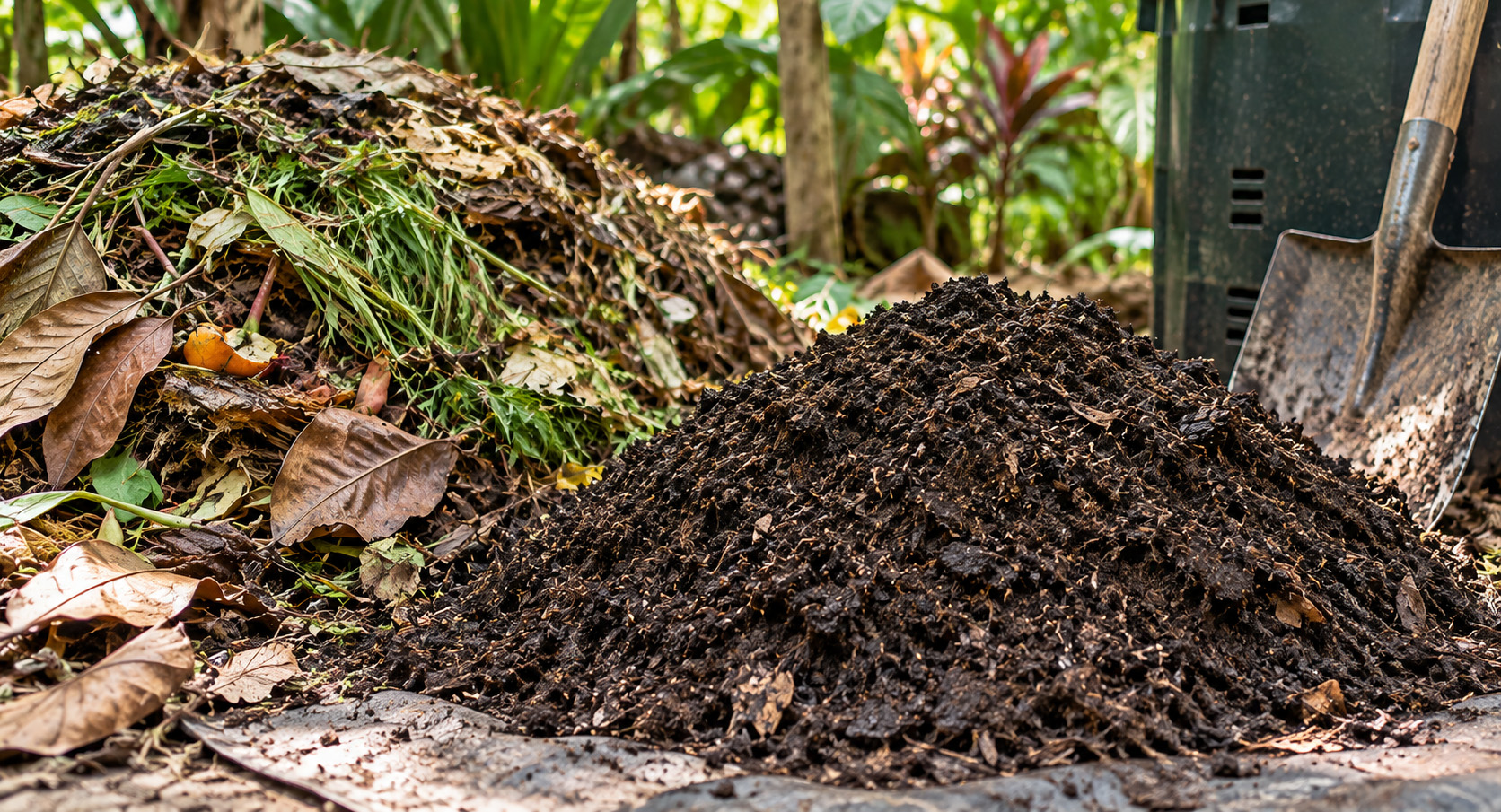
Tropical heat and moisture allow organic materials to decompose relatively quickly.
Different Types of Compost
The word “compost” can describe many different products. Their properties depend on what went into them and how completely they decomposed.
Garden Compost
Homemade garden compost may contain leaves, grass clippings, soft plant material, kitchen scraps and small woody materials. It is economical and allows you to recycle waste directly from your garden.
Composted Animal Manure
Chicken, cow and other animal manures can contain useful nutrients, but fresh manure may be too strong for plants and may contain excessive salts, ammonia or pathogens. Properly composted or aged manure is generally much safer for garden use.
Commercial Compost
Commercial products are convenient, but quality varies. Some are rich, dark and well decomposed, while others may contain large amounts of undecomposed wood, fibrous material or fine soil.
Vermicompost
Vermicompost is produced through the activity of composting worms and microorganisms. It is usually finer and is often used in smaller quantities around plants or as part of potting mixes rather than as the main bulk soil amendment.
How to Recognise Well-Matured Compost
Finished compost does not need to look perfectly uniform, but it should generally appear dark brown, crumbly and mostly decomposed.
- Have an earthy rather than rotten smell.
- No longer heat strongly after being turned.
- Contain few recognisable food scraps.
- Not feel slimy or excessively wet.
- Not contain large amounts of fresh manure.
- Look reasonably stable rather than actively decomposing.
Small pieces of twigs or leaves are not necessarily a problem. In fact, some coarser material can help maintain structure.
How Much Compost Should You Add?
There is no single correct amount because soils and compost products vary greatly. For an existing home garden, it is normally better to apply modest amounts regularly rather than suddenly replacing most of the soil with compost.
A layer of roughly 2–5 cm over the soil surface is a practical starting range for many garden beds. You can leave it near the surface or gently incorporate some into the upper soil layer.
Poor sandy soils may benefit from repeated additions over time. Rich soil with years of accumulated leaf litter may need much less.
Important:
Compost is an amendment, not automatically a complete replacement for mineral soil. Garden beds made almost entirely from very rich compost may retain excessive water, shrink considerably as the organic material decomposes, or develop nutrient imbalances.
Is Compost a Replacement for Fertiliser?
Sometimes, but not always.
Compost releases nutrients gradually, and the nutrient concentration is usually much lower and less predictable than a formulated fertiliser. This can be excellent for improving soil health, but plants with high nutrient demands may still benefit from additional fertilisation.
Think of compost mainly as a soil-building material that also supplies nutrients, rather than simply as an organic version of chemical fertiliser.
What About Compost Tea and Eco-Enzyme?
Compost tea and eco-enzyme are sometimes grouped together with compost, but they are actually different products.
Compost tea is a liquid made by extracting or steeping finished compost in water. Depending on the method used, it may contain soluble nutrients, organic compounds and microorganisms originating from the compost.
Eco-enzyme, sometimes called garbage enzyme, is normally produced by fermenting fruit or vegetable waste together with sugar or molasses and water over an extended period. It is therefore a fermented organic liquid rather than compost tea.
The main difference:
Compost is a solid soil amendment that adds substantial organic matter. Compost tea and eco-enzyme are mainly liquid preparations, so they contribute very little bulk organic matter to the soil.
These liquids may be used as supplementary garden inputs, but they should not be considered replacements for compost when your main objective is to improve soil structure, water retention or long-term organic matter content.
For beginners, I would still prioritise good soil, mature compost, suitable mulch, proper watering and sensible fertilisation first. Compost tea and eco-enzyme can be explored later once these basics are already working well.
Compost and Mulch Are Not Quite the Same
Both materials contribute organic matter, but they are normally used differently.
Compost is relatively decomposed and can be incorporated into the soil. Mulch such as dry leaves, wood chips or chopped plant material is normally placed on top of the soil.
Mulch protects the surface from intense tropical sunlight and heavy rainfall while slowly decomposing. In many tropical gardens, using both compost and mulch works better than relying heavily on either one alone.
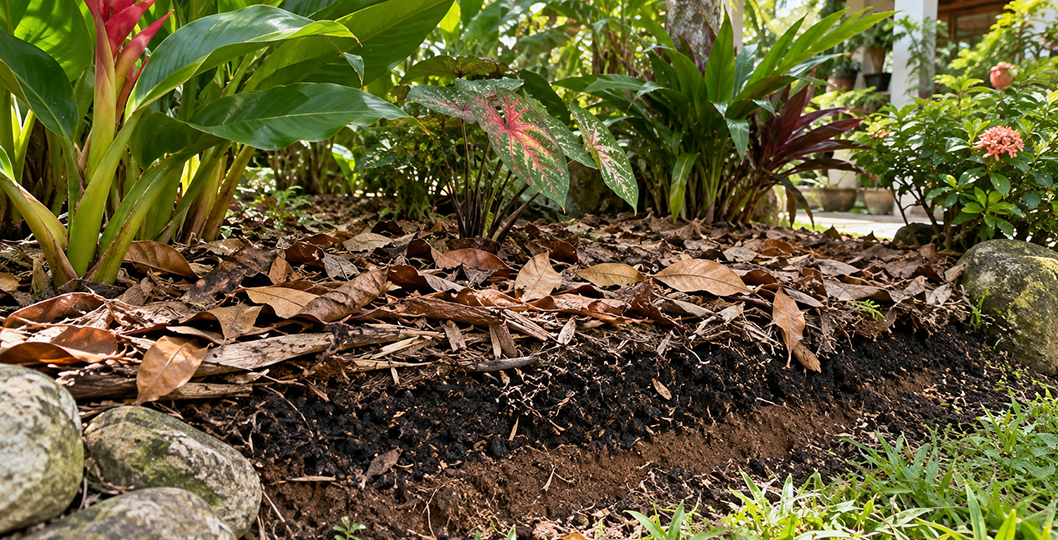
Compost improves the soil below, while mulch helps protect the soil surface.
What About Compost in Pots?
Compost can be useful in potting mixes, but containers require more careful drainage and aeration than garden soil.
Filling a pot entirely with fine compost is usually not ideal. As it continues decomposing, the mix may become compacted, hold too much moisture and lose volume.
A better approach is to combine compost with other materials such as cocopeat, composted bark, perlite, pumice, burnt rice husk or other suitable components depending on the plant.
This creates a better balance between nutrition, moisture retention and air around the roots.
Common Problems When Using Organic Matter
Adding Too Much
More organic matter does not always produce better growth. Extremely rich soils may encourage excessive soft growth or create nutrient imbalances.
Using Immature Compost
Material that is still decomposing rapidly may consume oxygen, generate heat or temporarily affect nutrient availability.
Poor Drainage
Compost cannot compensate for a site that remains waterlogged after every heavy rain. Drainage issues should be addressed separately.
Excessive Salts
Some manure-based composts and heavily fertilised commercial products can contain relatively high salt levels. Sensitive plants may respond poorly if too much is applied.
My Insights
Click each insight below to expand.
A Simple Routine for Tropical Gardens
For beginners, there is no need to make compost management complicated. A simple routine is usually enough:
- Observe the existing soil and drainage before adding anything.
- Apply a modest layer of mature compost when the soil appears depleted.
- Keep suitable leaf litter or mulch on the soil surface.
- Allow organic material time to decompose naturally.
- Watch how your plants respond before adding more fertiliser or compost.
- Repeat when necessary rather than following a rigid calendar.
Once you become familiar with your own garden, you will usually be able to tell when the soil needs attention simply from its texture, moisture behaviour and how your plants are growing.
In Short
- Compost is one form of decomposed organic matter.
- Its greatest benefit is often improving soil condition rather than simply supplying fertiliser.
- Organic matter decomposes relatively quickly in warm, humid tropical climates.
- Moderate, repeated applications are generally safer than adding huge quantities at once.
- Compost does not solve serious drainage problems.
- Compost and mulch can work very well together.
- Compost tea is a liquid extract of compost, while eco-enzyme is a fermented organic liquid; neither should be treated as solid compost.
- Potted plants normally require compost to be combined with materials that improve aeration and drainage.
- Observe your soil and plants instead of following a fixed formula.
Healthy tropical soil is not created by one product or one application. It develops gradually as roots grow, microorganisms work and organic material is continuously added and broken down.
Compost is therefore best treated as part of an ongoing soil-building process. Used sensibly, it can make your garden more productive, more resilient and much easier to manage over the long term.